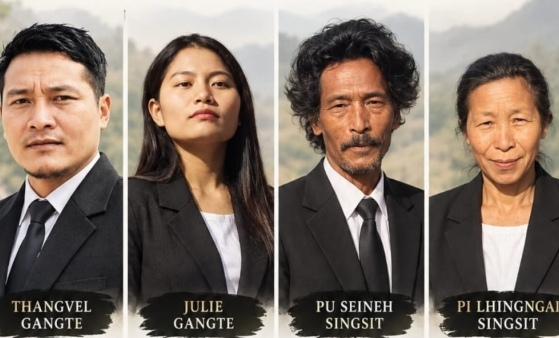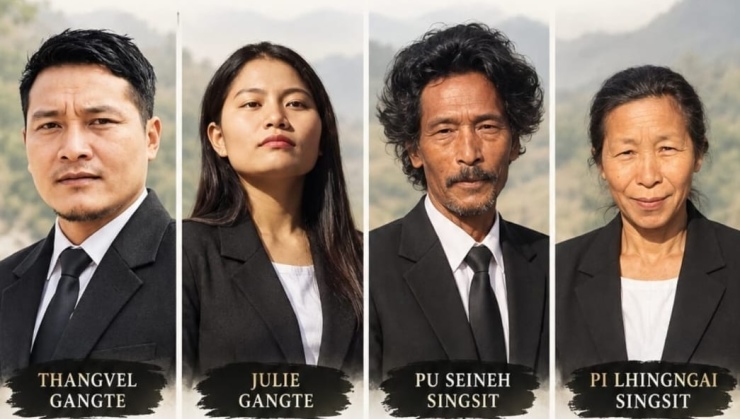
Four people from the Kuki community were killed in two attacks in Manipur’s Tamenglong and Noney districts on Sunday, the same day the community observed Sahnit Ni, or Kuki Black Day, a solemn annual commemoration of civilians killed during the Kuki-Naga conflict of the 1990s. A fifth person remains missing and is feared dead.
Manipur, a small state in India’s northeast bordering Myanmar, has been gripped by ethnic violence since 2023, primarily between the Meitei and Kuki-Zo communities. Alongside this, an older and separate fault line runs between the Kuki-Zo and Naga communities in the state’s hill districts, rooted in a conflict in the early 1990s that Kuki organisations say killed more than a thousand of their people, though independent estimates of the overall toll vary. Naga organisations dispute this account, rejecting characterisations of the 1990s conflict as one-sided and pointing to Naga civilian losses during the same period. Sunday’s bloodshed has revived fears of that older conflict resurfacing.
Sunday’s killings also fall within a months-long resurgence of Kuki-Naga violence in 2026. Three Kuki Baptist church leaders were killed in an ambush near Kangpokpi on May 13, followed by retaliatory abductions on both sides; six abducted Naga men were later found dead on June 10. On August 27, four Liangmai Naga civilians were killed in an ambush along the Imphal-Tamenglong corridor, and on August 31, an attack on the Kuki village of N. Teikhang in the same district left several civilians dead. Responsibility for these attacks remains disputed between the two communities in each case.
The first attack struck around 4 am at Tollen village in the Tousem area of Tamenglong district, a small Kuki settlement of about 250 people in 54 households on National Highway 37, the road linking Imphal to Jiribam. Armed men opened fire on the home of farmer Seineh Singsit, aged 54 according to one statement, killing his wife, Lhingngai Singsit, 42, on the spot. Their six-year-old son sustained bullet injuries and survived, while two other sons escaped unhurt. Seineh Singsit, critically wounded, died on the way to hospital at around 7 am the same morning, according to a memorial notice circulated via the ITLF Media Outlet; the Singsit Youth Organisation, a clan body, separately confirmed that both parents died on the same day in the same attack.
Kuki Inpi Jiri, Tamenglong & Noney (JTN), a district-level unit of Kuki Inpi, the Kuki community’s traditional tiered governing body, said the attack took place only a few hundred metres from a security post and sought clarification from authorities on how it could occur so close to a deployed force, while clarifying it was not questioning the capabilities of the Central Security Forces. The L. Tollen Village Authority alleged the attack was carried out by both NSCN(IM), a Naga armed group, and ZUF(K), a smaller allied armed group, calling it “a systematic and deliberate attempt to terrorize, uproot, and ethnically cleanse the Kuki-Zo villagers.” These allegations have not been independently verified by police. Soldiers from the Assam Rifles, a central paramilitary force stationed nearby, evacuated the injured towards Jiribam for treatment.
Later that afternoon, a second attack unfolded at Longpi Kuki village in Noney district. Julie Gangte was killed along with a male companion, Thangvel Gangte, while she was returning home carrying rice for her family. A second woman travelling with them is missing, with search efforts under way to trace her.
A copy of a press release on the Longpi attack, issued by the Western Village Volunteers (WVV), a Kuki-Zo village defence body covering the Jiribam, Tamenglong and Noney belt and formed on 23rd May 2026, was made available to Christian Today India by the ITLF/KZC Media Outlet. It said the attackers first killed the two civilians while they were “attending to essential household needs,” before advancing toward the village centre, where WVV volunteers confronted and drove them back after a clash it described as fierce. Local sources again named NSCN(IM) and ZUF(K) as suspects, an allegation that remains unconfirmed.
The killings drew condemnation from Kuki civil society groups and political leaders alike. Kuki Inpi JTN called the Tollen attack an attempt to wipe out an entire family, demanded the case be handed to India’s National Investigation Agency, and sought permanent security deployment at the village. It gave the government 24 hours to act or face an indefinite shutdown, alongside an immediate 24-hour economic blockade, and said Lhingngai Singsit’s family would not accept her body for funeral rites until justice was delivered. The L. Tollen Village Authority separately demanded an FIR, an independent probe and urgent intervention from the National Human Rights Commission.
WVV demanded that those behind the Longpi killings be identified and punished within 24 hours, warning of a strong retaliatory response if this did not happen. The Kuki Youth Organisation’s Women’s Council said the attack was especially painful coming on Black Day, and called for stronger intelligence, effective protection for women and children, and transparent accountability.
Letzamang Haokip, an MLA from Henglep constituency in Churachandpur district, denounced “the brutal attack and killing of 4 (four) innocent Kuki civilians, including a pregnant woman,” and urged security agencies to identify and apprehend those responsible. Awangbow Newmai, a Naga MLA from Tamei in Tamenglong district and president of the Naga People’s Front’s state unit, also denounced the killings as a senseless attack on unarmed civilians, calling on all communities to shun violence and work towards peace.
The Kaimai Naga Village Authority, representing a predominantly Naga village near Tollen, criticised the attack independently, describing the perpetrators as an unidentified group and appealing for restraint between communities, saying it stood firmly for “peace, unity and communal harmony.”
As of the time of reporting, police had not issued a detailed public statement on the Longpi attack, and had said, regarding Tollen, that no group had yet claimed responsibility.