The Eiffel Tower closed for an entire day on Monday, September 7, after its staff went on strike, protesting the alleged removal of female colleagues from their posts during a private visit by a Hindu religious delegation. The tower, one of the world’s most visited monuments, reopened as normal on Tuesday, even as French authorities launched an investigation into what exactly transpired.
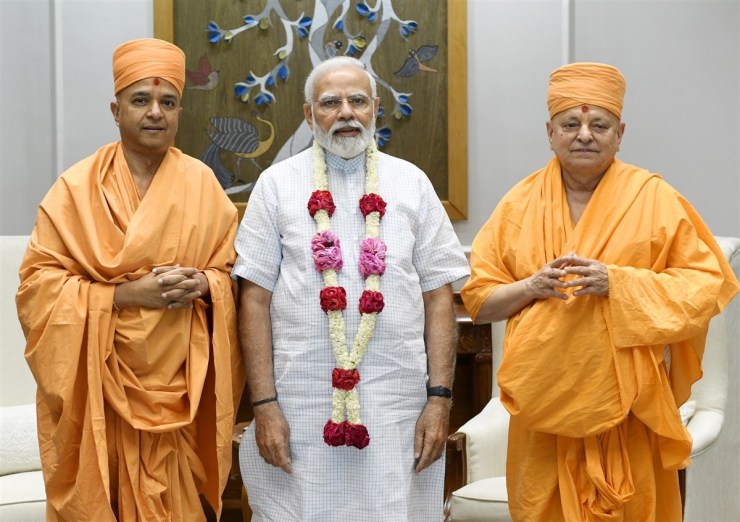
The controversy began on Saturday, September 5, when around 100 people linked to the Bochasanwasi Akshar Purushottam Swaminarayan Sanstha, commonly known as BAPS, made a private visit to the Eiffel Tower. BAPS is a Hindu spiritual organisation with roots in the western Indian state of Gujarat, and is close to Prime Minister Narendra Modi’s Bharatiya Janata Party, India’s ruling party. The visit fell during a week of celebrations around the inauguration of BAPS’s first major temple in France, located in Bussy Saint Georges near Paris. The temple was consecrated the following day, on Sunday, with Prime Minister Narendra Modi addressing the ceremony through a video message and calling it a milestone in India France cultural relations.
In a joint statement, Eiffel Tower staff condemned what they called “professional instructions that led to female employees being sidelined, replaced and made invisible because of their sex.” They said some employees “were asked to leave their posts and withdraw to other areas,” and that “all female employees were instructed not to go through or cross certain areas while the delegation was present.”
Diane Davoine, a union representative, told Reuters that “women were asked to leave their places of work in order to place men there.” She said “that absolutely does not go down well with the employees, with women obviously, who are all humiliated by what happened, by the way some were treated,” adding that management had repeatedly apologised for what occurred.
The Societe d’Exploitation de la Tour Eiffel, known as SETE, which operates the monument, confirmed to AFP that the BAPS delegation had indeed requested that the visit be arranged to limit “interactions with women.” The company acknowledged that “these conditions should not have been accepted,” and said the arrangement was “not in line with SETE’s values, nor with the principles of equality between men and women.” SETE president Ariel Weil called it “clearly not an acceptable practice” and reaffirmed “the Eiffel Tower’s commitment to republican values and to the equality of men and women.”
The strike forced the tower’s closure on Monday, disrupting a site that draws close to seven million visitors annually.
BAPS has issued more than one statement on the matter. In an initial statement posted on social media by BAPS Mandir Swaminarayan Hindou de Paris, the organisation said it took the concerns raised “very seriously,” and that owing to the size of its delegation, the visit had been “organised in coordination with the Eiffel Tower team at the start of normal opening hours” to limit disruption to other visitors. The statement added, “To the best of our knowledge, at no point was anyone prevented access to the Eiffel Tower,” and offered an apology “for any pain or inconvenience caused.”
When contacted separately by CNN, BAPS Paris issued a further statement asserting more directly that the arrangement was not about gender at all. “It was never, at any point, intended as a request rooted in gender, and any suggestion to the contrary does not reflect the spirit or values of our fellowship or the delegation,” the statement said.
The episode drew swift, largely unified condemnation from French politicians across the ideological spectrum. Equality Minister Aurore Berge wrote on X, “In France, we do not ask women to erase themselves. No dogma, no religion is above the laws of the Republic.”
National Assembly President Yael Braun-Pivet said she “refuses to accept that women should be told to step aside to meet the demands of foreign visitors,” and that “welcoming others never means giving up our values. In France, women are fully present in public life.”
Ile-de-France regional council president Valerie Pecresse said she was “shocked” by the reports, adding that she had “personally informed the representatives of BAPS in France that such practices are contrary to the laws of the Republic.”
Former prime minister Michel Barnier called it “utterly unacceptable that an order aimed at making women disappear from this space could have been issued,” and said “it is not practices from elsewhere that dictate to women how to dress or exist in public spaces.”
Far right leader Marine Le Pen said France would “never accept that women’s presence be limited,” while centrist presidential contender Gabriel Attal said “no culture, no belief, no religion, nothing and no one can come and dictate to women what their place should be.”
Paris Mayor Emmanuel Gregoire announced that the city would launch a formal investigation into the circumstances surrounding the visit and how the arrangement came to be approved. He said equality between men and women must hold everywhere in Paris, including at its historic monuments, and acknowledged that the anger among Eiffel Tower staff was legitimate.
BAPS describes itself as a socio spiritual Hindu faith with more than 5,000 centres worldwide and over a million followers. Its monks observe strict vows of celibacy, which the organisation says require them to avoid physical contact and interaction with women as a matter of spiritual discipline. The organisation has built prominent temples in several countries, including the United States, United Kingdom and United Arab Emirates.
BAPS has also drawn academic scrutiny over its place within Hindu nationalist politics in India, a movement often referred to as Hindutva. Martha Nussbaum, a philosopher at the University of Chicago, has written about the wider Swaminarayan sect of Hinduism, of which BAPS is the largest global denomination, describing it as marked by “uncritical obedience” to its spiritual leader. In her book The Clash Within, Nussbaum recounted a visit to a Swaminarayan temple in the United States where a devotee recited to her what she called “the simplistic Hindu-right story of India’s history.” Separately, scholars including Chetan Bhatt and Parita Mukta have argued in academic literature that BAPS displays what they describe as “soft Hindutva affinities,” with Bhatt arguing the organisation has sought to “hegemonize the space of Hindu representation” in the diaspora.
As of Tuesday, the investigation ordered by Paris authorities remained underway. SETE has acknowledged accepting a request to limit interactions with women, while BAPS maintains that its request was not motivated by gender. Findings are awaited.