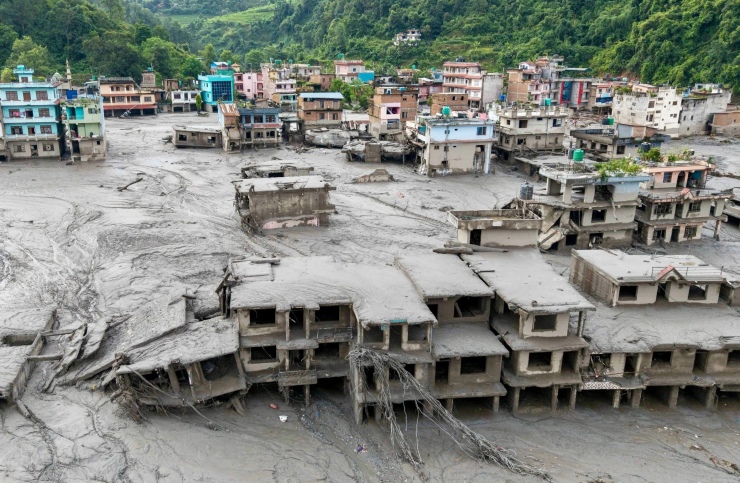
Four days after flash floods tore through the Nepal-Tibet border region, the death toll in Nepal has climbed to 768. Another 2,498 people are still listed as missing, according to a Nepal Police bulletin issued at 11 am on Sunday, 30 August. Across the border in Tibet’s Shigatse region, Chinese authorities have confirmed 16 dead and 546 missing.
Together, the two countries are looking for close to 3,000 people. Rescue crews caution that some of those “out of contact” may simply be cut off by broken roads and dead phone lines, rather than dead.
The numbers have moved sharply since Christian Today India’s last report on the disaster. On the day of the flood, 26 August, Nepal’s death count stood at a provisional 18, with 384 people unaccounted for.
That number has been revised upward almost daily as bodies are recovered downstream, and as communication is slowly restored to villages that went dark when the Bhote Koshi river, which flows down from Tibet into Nepal’s Rasuwa district, surged without warning.
Nepal’s Disaster Management Authority said on Saturday evening that at least 675 people had been confirmed dead. That figure rose further to 768 by Sunday afternoon. A day earlier, the disaster authority had put the missing at 2,426, split between 1,863 Nepali citizens and 499 foreign nationals; Sunday’s police count of 2,498 missing has not yet been broken down the same way.
India’s own toll has grown too. India’s Ministry of External Affairs (MEA), the government department that handles foreign affairs and the welfare of Indian citizens abroad, has been issuing regular updates through its spokesperson.
MEA Spokesperson Randhir Jaiswal, in a post on X as of 22:30 hours on Saturday, said 108 Indian nationals had been rescued. Contact was re-established with a further group of Indian nationals earlier reported untraceable.
Separately, 598 Indians who had been stranded on the Chinese side of the border safely crossed into Nepal over the preceding two days. Around 900 more, Jaiswal said, remain in China awaiting departure, described as safe and in touch with the Indian Embassy in Beijing.
Efforts continue, he said, to trace 275 Indian nationals and 128 Persons of Indian Origin (a legal category for people of Indian descent holding foreign citizenship) still reported missing. Four Indians, Ripu Kumar, Chaneshwar Narzary, Kripa Shankar and Mohammed Minhajuddin, were rescued from a hydropower project in Rasuwa.
External Affairs Minister S Jaishankar said an Indian Air Force C-130J transport aircraft had flown in a fourth batch of relief material, 11 tonnes in all. The consignment also carried a tunnel rescue team with specialised equipment, and a team of forensic experts with DNA analysis equipment to help identify the dead.
The MEA said a round-the-clock control room has been set up in Delhi, with helplines running out of the Indian missions in Kathmandu and Beijing. India and Nepal, the ministry noted, have deep historical and people-to-people ties, and New Delhi is coordinating closely with both Kathmandu and Beijing given that citizens from all three sides of the border are caught up in the disaster.
Nepal’s National Disaster Risk Reduction and Management Authority (NDRRMA), the country’s apex disaster response body, has begun cataloguing the scale of infrastructure lost. Its count so far: 35 motorable bridges gone, 45 suspension footbridges of the kind common across Nepal’s hill terrain destroyed, and close to 40 kilometres of road damaged or washed away, cutting off travel across nine districts.
Among the worst-hit stretches is the road linking Betrawati in Nuwakot district to the Rasuwagadhi border crossing, Nepal’s main overland trade link with Tibet. Officials say it no longer exists as a driveable road.
Most of the dead have turned up far from where the flood began. Nepal Police records show 259 bodies recovered in Chitwan district, 184 in Nawalparasi East, and dozens more further south in Nawalparasi West and Gorkha, carried there by the same current that tore through Rasuwa. Only 13 bodies have been found in Rasuwa itself, where the wall of water, ice and rock first broke loose.
One of the most anxious fronts in the rescue effort has been underground. Many of Nepal’s hydropower stations draw river water through long tunnels bored into hillsides, feeding underground powerhouses below.
The Independent Power Producers’ Association, Nepal (IPPAN), an industry body, says more than 900 people linked to hydropower projects along the Trishuli river corridor remain unaccounted for. Officials believe many are trapped inside these flooded tunnels and powerhouses.
At the Trishuli-3A project in Rasuwa, the Prime Minister’s Office said 82 army and police personnel worked through the weekend to dig out a tunnel entrance, pumping air and food through bored holes after failing to raise anyone inside on radio.
Elsewhere along the corridor, the Nepali Army has released footage of soldiers dragging survivors out through thick, frozen mud, an operation officials say has already brought hundreds of trapped workers to safety, even as rescuers acknowledge that an unknown number remain unreached. India and China have both sent tunnel rescue specialists at Nepal’s request.
Damage to the power sector keeps being revised upward. The state-run Nepal Electricity Authority’s early estimate had put the loss at roughly 430 megawatts of generating capacity. A more recent tally circulated by relief agency CARE puts the number of hydropower and solar projects hit at 14, with a combined capacity of about 748 megawatts, a unit used to measure electrical output.
There was fresh alarm in the valley on Sunday morning. The NDRRMA said water levels in the Bhote Koshi had risen again overnight and asked rescue teams and riverside residents in Rasuwa, Nuwakot, Dhading and Chitwan to stay alert. A text warning went out to residents at 4.30 am local time, though authorities stopped short of ordering fresh evacuations.
A landslide near the Nepal-China border on Saturday evening added to the unease. It formed a new barrier lake, a temporary pool created when landslide debris dams a river channel, close to Gyirong Port on the Chinese side. Chinese rescue teams withdrew from the immediate area as a precaution.
Money is beginning to flow toward recovery even as search operations continue. Nepal’s Prime Minister Balendra Shah’s office said on Saturday that more than Rs 5.04 billion (roughly USD 36 million) has been deposited across nine commercial bank accounts opened for rescue and relief work. Early estimates put total damage at around Rs 200 billion (close to USD 1.4 billion).
The United States has more than tripled its humanitarian pledge to Nepal since this paper’s earlier report, raising it to USD 3.6 million, which includes emergency food assistance for up to 10,000 flood-hit households. India’s own assistance, detailed above, continues alongside work by Direct Relief and other international agencies operating with Nepal’s Ministry of Health.
Nepal’s churches have been quietly present in the response almost from the first hours.
The National Churches Fellowship of Nepal (NCFN), the country’s recognised Evangelical Alliance body and a member of the World Evangelical Alliance (WEA), and the Nepal Christian Society (NCS) launched a joint response from Kathmandu even as the water was still rising.
Three assessment teams set out for the affected valleys on mountain bikes after roads became impassable for vehicles. A medical rescue team was also readied. Local church leaders have since been seeking district-level clearances to widen the scope of their work as access slowly improves.
The WEA, which is channelling donations for the response through NCFN and NCS, said that of six churches it had on record in Timure, one of the worst-hit settlements in Rasuwa, two are reported to have been swept away, though this has not been independently confirmed on the ground.
Figures circulating within these church networks put believer deaths at more than 125 across the affected valleys. Officials cited by the WEA describe this figure as provisional, pending further search and assessment work.
Communication breakdowns have hit an estimated 8,000 people in the affected valleys, church leaders reported, and more than 40 percent of roads in the belt have been destroyed or badly damaged, cutting many congregations off from outside contact.
Rev. Dilli Ram Paudel of the Nepal Christian Society has called for prayer on several fronts: for the families of the missing and the bereaved, for the safety of rescue and medical workers still operating in the gorge, and for churches and households caught directly in the flood’s path.
Relief agencies working through Nepali congregations have echoed a common theme in their appeals this week: that local churches, already rooted in these communities, are best placed to keep serving them long after international attention moves on.
Send Relief, the humanitarian arm of the Southern Baptist Convention in the United States, said it is routing food packages of rice, lentils, cooking oil and salt through partner churches already present in the disaster zone, rather than setting up parallel operations of its own.
With the Bhote Koshi still swollen and forecasters unable to rule out further landslides upstream, government agencies and church networks in Nepal agree on one point: the emergency is not over. Search and rescue continues even as the country begins turning toward the long work of rebuilding.