The Cockroach Janta Party (CJP) has alleged that police have served notices on its activists in Maharashtra, asking them to stay away from the group's proposed agitation at Jantar Mantar in the national capital on 10 October.
“A physical copy of the notice was served to my father at home on 5 Oct. 26 and a digital notice was sent to me through WhatsApp on the same day,” confirmed Madhur Premanand Malkhede to Christian Today.
What was perplexing was that both the copies were not identical. “The one sent to me digitally had few lines added and emphasised in bold,” said Malkhede.
The digital notice has additional warnings like: to not participate in the protest “without permission”; to not post “violent posts on social media” and to not give “provocative speech” during the protest, among others.
The digital notice has a seal of ‘Police Station Ballarpur district Chandrapur’, which is missing from the physical copy.
CJP called the action of sending such notices as an act of “dictatorship”.
Abhijeet Dipke, the founder and convener of CJP addressing a press conference in Chhatrapati Sambhajinagar on October 6, claimed that the Chandrapur police had served notices on CJP workers directing them not to participate in the Jantar Mantar agitation, and had also questioned them about the source of funds for their travel expenses.
Dipke also tweeted on his X handle questioning the police warning that the protest could turn violent.
“How can they make such a claim? Is something already being planned to disrupt our peaceful protest?,” reads his tweet.
"We speak about (Mahatma) Gandhi and B R Ambedkar. Do they think it is violent?" Dipke said in the Press Conference.
He further asked why the Chandrapur police should concern themselves with a person travelling from Maharashtra to Delhi. Targeting the BJP-led central government, he said "One Nation, One Election" was merely a slogan and the real intention was "one nation, one political party".
According to Malkhede two social media influencers like himself have received notices with added warnings and about five activists who were present at Jantar Mantar in July have received notices.
CJP co-convener Saurav Das told media that they have received news that their leaders could be arrested before October 10. "It does not matter if we are arrested or detained because this fight is about the young generation," said Das. He added that protesters would sit wherever the police stopped them, and that "fear of FIR, fear of jail has evaporated".
Why the protest
The CJP, a Gen Z-led group that began as an online satirical movement, forced the resignation of education minister Dharmendra Pradhan in July, is now demanding the resignation of Chief Election Commissioner (CEC) Gyanesh Kumar over alleged manipulation of voter rolls.
The protests centre on the Election Commission's Special Intensive Revision (SIR) of electoral rolls. The Election Commission says the exercise is meant to remove duplicate and ineligible entries, and the BBC reported that 130 million names have been struck off the voters' list so far. Opposition parties and activists allege that many of those deleted are eligible voters. Both the BJP and the Election Commission have rejected the allegations.
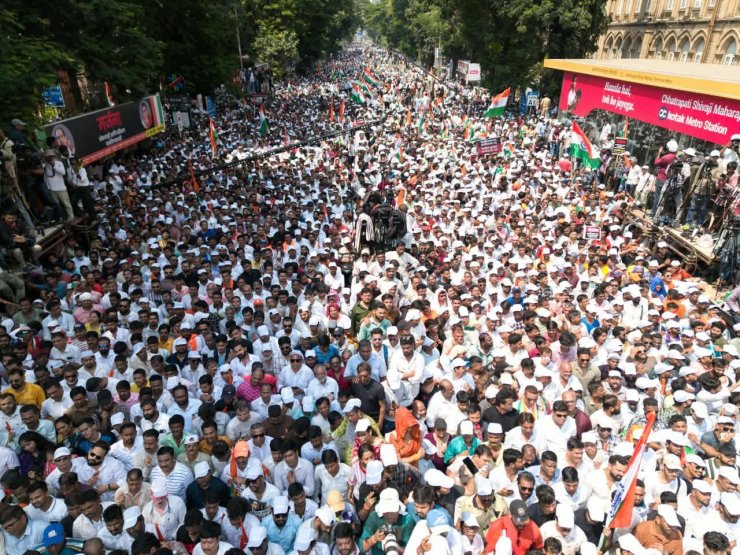
Thousands joined a CJP protest at Shivaji Park in Mumbai on October 2, while police in Delhi detained hundreds who tried to gather at Jantar Mantar.
The two Election Commissioners
The immediate trigger was an investigation by The Indian Express published on 23 Sep. which reported that Election Commissioners Sukhbir Singh Sandhu and Vivek Joshi had recorded formal objections at least 14 times in 10 months to decisions and orders issued, they said, without their knowledge. The objections related to new voter registration, deletion and restoration of names, and the custody and security of the electoral roll database. In one objection, Sandhu described the changes in Form 6 as "unauthorised and illegal". Both commissioners also wrote separately to the Cabinet Secretary over changes in work allocation affecting oversight of the IT backbone.
The Election Commission has said "differing views" are part of its decision-making process and that all decisions were taken unanimously.
What the Supreme Court has ordered
The dispute has also reached the Supreme Court. On Monday, 5 October, a bench led by Chief Justice of India Surya Kant, with Justices Joymalya Bagchi and V Mohana, refused to pass an interim order suspending Gyanesh Kumar, but issued notice to the Election Commission, the CEC and the two Election Commissioners on pleas challenging the decisions taken by the poll body during the SIR, The Times of India reported. The pleas were filed by Patna resident Rakesh Kumar Singh and advocate Shailendra Mani Tripathi, and they question whether the CEC exercised powers belonging to the full Commission without the approval of Sandhu and Joshi.
The court sought the Commission's records to find out who authorised the changes to Form 6, the form used by new voters to register themselves. "Any modified Form 6 has not been approved by us. Let's be clear. When record has produced, we would like to see who has modified. But, your prayers appear jumbled up," the CJI observed. Justice Bagchi added, "If records show some decision was not unanimous etc., we will injunct those decisions and say they are ultra-vires. Can we ex-parte come to decision that all decisions were unilateral? We expect them to respond in a clear, transparent manner."
The court took up the matter because the petitioners alleged a breach of the Commission's multi-member character. One plea sought the CEC's suspension till the final hearing and asked that Sandhu and Joshi run the Commission's business in the meantime, relying on Section 18 of the Chief Election Commissioner and Other Election Commissioners Act, 2023, under which the majority view prevails when commissioners differ. The second plea sought criminal proceedings against the CEC and other officials and a declaration that all decisions, guidelines and software changes made without the full Commission's agreement are "unconstitutional, ultra vires and void ab initio". The pleas further allege that a requirement for ancestral details and a link to the previous SIR was added to Form 6 through the poll panel's software without amending the election rules, that the software lacked a feature to restore 97 eligible voters in Goa, and that more than 16.10 lakh appeals were filed in the Commission's name in West Bengal against voters whose names had been restored by judicial officers, The Times of India reported.
India Today reported that the Commission's defence is that it never modified statutory Form 6 and only added a supplementary declaration for the SIR, drawing on the Supreme Court's May judgment on the Bihar SIR, which held that the Commission retained "a degree of residual authority" to frame a documentation framework for such an exercise. The same judgment, however, said that power was "not unbounded, and any departure from the statutory framework had to have a rational connection with the objective of the SIR". According to India Today, the Commission has already removed the additional declaration from its ECINet portal in states where the SIR has been completed, while retaining it where the exercise is continuing.