Christian denominations across India came together on Sunday, 28 June, to observe a National Day of Prayer and Fasting against the proposed Foreign Contribution (Regulation) Amendment Bill, 2026, with the Catholic Bishops’ Conference of India (CBCI), the National Council of Churches in India (NCCI) and the Evangelical Fellowship of India (EFI) all calling on their members to take part, alongside the Joint Action Forum on Minorities (JAFM), which coordinated the day at a national level.
The Union Government introduced the Bill in Parliament in March 2026, and it is expected to come up during the Monsoon Session. JAFM said the day drew lakhs of devotees from various denominations, with special prayer meetings held by religious institutions and community organisations across the country for the nation, constitutional governance, democratic freedoms and the withdrawal of the Bill.
In a circular dated 17 June addressed to all bishops, priests, religious and lay faithful, CBCI President Cardinal Anthony Poola, Metropolitan Archbishop of Hyderabad, asked Catholics across the country to set aside 28 June for prayer, asking that the day bring the Church together around the nation, those who govern it, and the Church’s own ability to keep serving. The circular pointed to worries that the Bill could disrupt the work the Church does in charity, education, healthcare and social service, and Cardinal Poola framed this work as flowing directly from the Gospel call to love, justice and compassion. He asked Catholics to mark the day alongside other denominations as one shared expression of concern, through Mass, Eucharistic Adoration, the Rosary, organised prayer services and fasting by those who chose to. The circular further suggested that dioceses, parishes and institutions could prepare memoranda on the Bill for submission to the government through local MPs and MLAs. At the CBCI Centre in New Delhi, nine hours of continuous Eucharistic Adoration was held on the day, opened with prayers led by Fr Mathew Koyickal, deputy secretary general of CBCI, for guidance, protection and wisdom for the country’s leaders and people.
NCCI marked the day with a campaign built around the theme “We Oppose FCRA Amendment Bill 2026,” listing the direct and indirect impacts it said the Bill could have, including the takeover of church properties, loss of rental and lease income from properties used for poverty alleviation, a deadlock on the educational and healing ministries of churches and missions, continued subjugation of Dalit and tribal communities whose causes churches have addressed, violation of the constitutional rights of minorities without recourse to judicial relief, reduced involvement in humanitarian assistance programmes, and an impact on the achievement of Sustainable Development Goal targets. NCCI had earlier written to parliamentarians opposing the Bill, with its General Secretary, Rev. Asir Ebenezer, describing it as raising serious concerns, including the absence of judicial process before assets are taken over.
In a letter dated 16 June to its member bodies, state fellowships, churches, ministries and individual believers, EFI General Secretary Rev. Vijayesh Lal said Christian leaders, churches and civil society voices had expressed concern in recent months over the proposed Bill and its possible implications for charitable, educational, humanitarian and faith-based ministries. He said EFI had been engaging with Christian leaders, legal experts and elected representatives to understand these implications, and noted that wider consultations had called for 28 June to be observed as a special day of prayer and fasting. Lal wrote that the Church took these concerns seriously, yet without anxiety or despair, citing scripture’s call to pray for those in authority. He asked churches and fellowships to set aside time during worship services, prayer gatherings and personal devotions to pray for the nation and its leaders, for the continued freedom of churches and Christian ministries to worship and serve, for educational, healthcare, relief, development and charitable institutions, and for unity and discernment among Christian leaders.
Ahead of the day, JAFM circulated a prayer guide titled “A Call to Prayer, Declaration and Thanksgiving,” prepared by Rev. Robin Paul, for use across churches in India. The guide included prayers of thanksgiving recalling the restoration of an FCRA registration in January 2022 connected to Mother Teresa’s legacy and the earlier deferment of the proposed Bill, prayers of repentance, prayers for the nation’s leaders and civil servants, and a specific prayer asking that provisions hindering charitable, educational, humanitarian and faith-based ministries be reviewed, modified or removed.
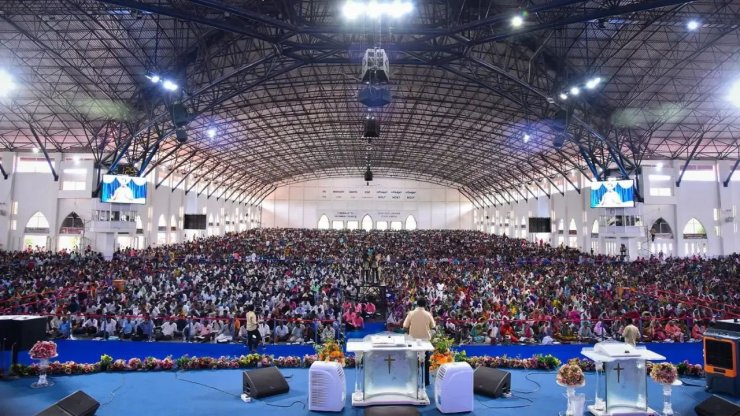
In Tamil Nadu, one of the largest single gatherings of the day was held at Nallumavadi, where an estimated 75,000 people gathered for a special prayer meeting led by Pastor Mohan C. Lazarus. Prayers were offered there for the nation, constitutional values, peace, justice and the withdrawal of the Bill, and for the protection of religious, educational, healthcare, charitable and humanitarian institutions serving people across the country. JAFM thanked Pastor Lazarus, the organising team and the participants, and said the turnout reflected growing nationwide support for the movement.
JAFM also held a National Prayer Webinar on the evening of 28 June, between 4 pm and 7.30 pm, chaired by Mr P. Wilson, Member of Parliament and JAFM Chairman, and convened by Mr John Samuel, drawing more than 500 participants online from across the country. The webinar brought together Members of Parliament, religious leaders, representatives of various denominations, political party representatives, charitable organisations, educational and healthcare institutions, legal experts, civil society organisations and community leaders.
Addressing the gathering, Mr Wilson said the day’s participation showed that concerns over the Bill extended beyond any single denomination or community, with institutions serving the nation through education, healthcare, humanitarian aid and social welfare uniting to defend constitutional rights through peaceful and democratic means. He announced a Nationwide Signature Campaign, asking institutions to collect signatures and submit representations seeking withdrawal of the Bill to the Prime Minister through District Collectors, and called for preparations to intensify ahead of the National Protest Day on 3 July 2026.
Ms Kanimozhi Karunanidhi, MP and Leader of the DMK Parliamentary Party, spoke of concerns over the expansion of executive powers, the proposed Designated Authority and the vesting of assets under the Bill, and referred to a letter written by DMK President Mr M. K. Stalin to the Prime Minister seeking its withdrawal. Mr Derek O’Brien, MP of the All India Trinamool Congress, said democratic engagement must accompany prayer, while Dr D. Ravi Kumar, Mr Christopher Tilak, Mr A. A. Rahim and Dr Kalanidhi Veersamy, among other Members of Parliament, also spoke against the Bill.
Special prayers and messages of solidarity came from a wide range of church and civil society leaders, including Fr Joe Arun SJ of the Tamil Nadu Minorities Commission, Mr Pravesh Solomon of the Jharkhand Minority Commission, Rev. Asir Ebenezer of NCCI, Paul Dhinakaran of Jesus Calls, representatives of the Kuki Christian Leaders’ Forum, Mrs Kunjamma Mathew of the National YWCA, and several bishops, pastors and legal experts from across India, with participants from outside the country also joining in.
JAFM thanked all participating organisations and reiterated that the movement is not confined to any single religion or community but is a constitutional effort to defend democratic freedoms and the institutions serving millions through education, healthcare and social welfare. The Forum called on citizens and institutions to continue the Nationwide Signature Campaign and to prepare for the National Protest Day on 3 July 2026 through peaceful, democratic and constitutional means.