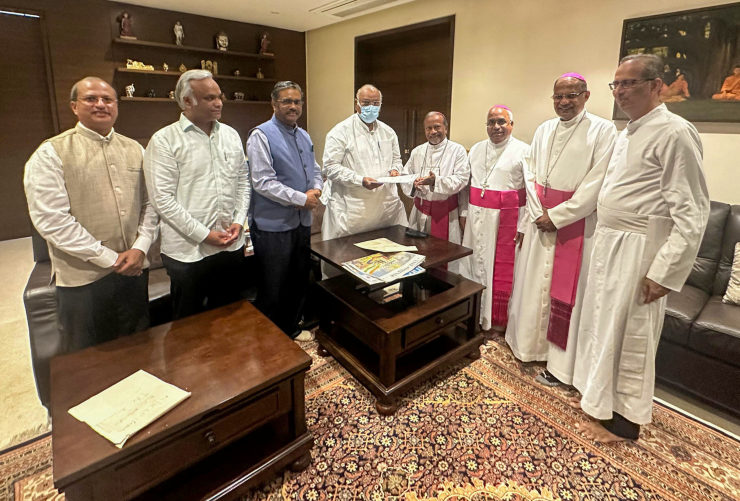
A delegation of Christian leaders from the southern Indian state of Karnataka called on Mallikarjun Kharge, president of the Indian National Congress, at his residence in Bengaluru on Monday, September 14, pressing him on a set of long-pending demands, chief among them the repeal of the state’s anti-conversion legislation.
The press release on the meeting was sent to Christian Today India by Dr John Dayal, veteran human rights activist and spokesperson of the All India Catholic Union.
Archbishop of Bangalore, Most Rev. Dr. Peter Machado, led the delegation. The Archdiocese of Bangalore is the Catholic administrative region covering Bengaluru, India’s technology hub. Also present were Bishop Peter Paul of Mangalore, Bishop Francis Serrao of Mysore, Fr Arun Lewis SJ, Director of Ashirwad, and lay representatives Praveen Peter, Anthony Vikram and J. A. Kanthraj, PRO and spokesperson of the Archdiocese of Bangalore. Karnataka’s Home Minister, Priyank Kharge, son of Mallikarjun Kharge, was present too.
Mallikarjun Kharge is Leader of the Opposition in the Rajya Sabha, the upper house of India’s Parliament, besides heading the Congress at the national level. Congress currently runs the Karnataka government, which gave the meeting its political weight. According to the statement, the delegation had “sought his intervention and support in addressing these issues and ensuring that the legitimate concerns and aspirations of the Christian community receive due consideration at the appropriate levels of government.”
Four issues came up for discussion, the statement said. First was a call to scrap the Karnataka Protection of Right to Freedom of Religion Bill, 2021, better known as the Anti-Conversion Bill. Such laws exist in several Indian states and are pitched as safeguards against forced religious conversion, though Christian groups have repeatedly said they end up restricting the constitutional freedom to profess and spread one’s faith. The delegation raised concerns “regarding the provisions of the legislation and its implications for the Christian community, particularly with regard to the exercise of constitutional freedoms and the right to practise and propagate one’s faith.”
Second, the group pushed for a Christian nominee to the Karnataka Legislative Council, the state’s upper house, where a share of seats go not to elected members but to nominees chosen by the Governor on the government’s recommendation. Such representation, the delegation said, “would provide the community with an appropriate platform to voice its concerns and contribute constructively to the legislative process.”
Third came a request for a one per cent reservation, India’s quota system that reserves government jobs, college seats and welfare benefits for specified groups, carved out exclusively for Christians within the Backward Class category, citing “the socio-economic challenges faced by sections of the Christian community.”
Fourth, the delegation asked for “adequate and meaningful representation” of Christians on government boards, corporations and other statutory and nominated bodies, saying this would let the community “participate more effectively in public administration and contribute to the development of the State.”
Kharge, the statement said, gave the delegation “a patient and attentive hearing” and “engaged in a detailed discussion on the various issues presented before him.” He assured them that he “would take up the issues with the concerned leaders of the State Government and provide the necessary directions for their consideration and appropriate action.”
The delegation, in turn, “expressed its appreciation to Shri Mallikarjun Kharge for granting them an audience,” and said it hoped the concerns raised would receive due attention from the state government.
Dr Dayal told Christian Today India that the community’s patience was wearing thin. “The Christian community in Karnataka has had a long wait to feel that the Congress promise of change, when it took power, will also bring a change in their political situation. The anti-conversion law the BJP imposed still sits on the statute book years later, untouched, and its threat can be carried out by an errant bureaucrat or a rogue police officer. Repealing it should have been among the first acts of this government,” he said. “There is only one Christian in the cabinet, and almost none on boards or corporations, as the community’s demands go unheard. The Legislative Council nomination has been talked about for years without a single Christian voice in that house. The Christian community remains at the margins of every decision-making body. The chief minister and the Congress high command need to act, and not take the Christian community for granted.”
Monday was not Archbishop Machado’s first attempt to get the law reconsidered. He had earlier approached the Chief Minister, the Governor and district officials when the bill was first tabled and again after it was signed into law, arguing that it violates Articles 25 and 26 of India’s Constitution, which protect freedom of conscience and a religious community’s right to manage its own affairs.
The meeting also came soon after a reshuffle in the state cabinet: Priyank Kharge took over the Home portfolio only in June this year.