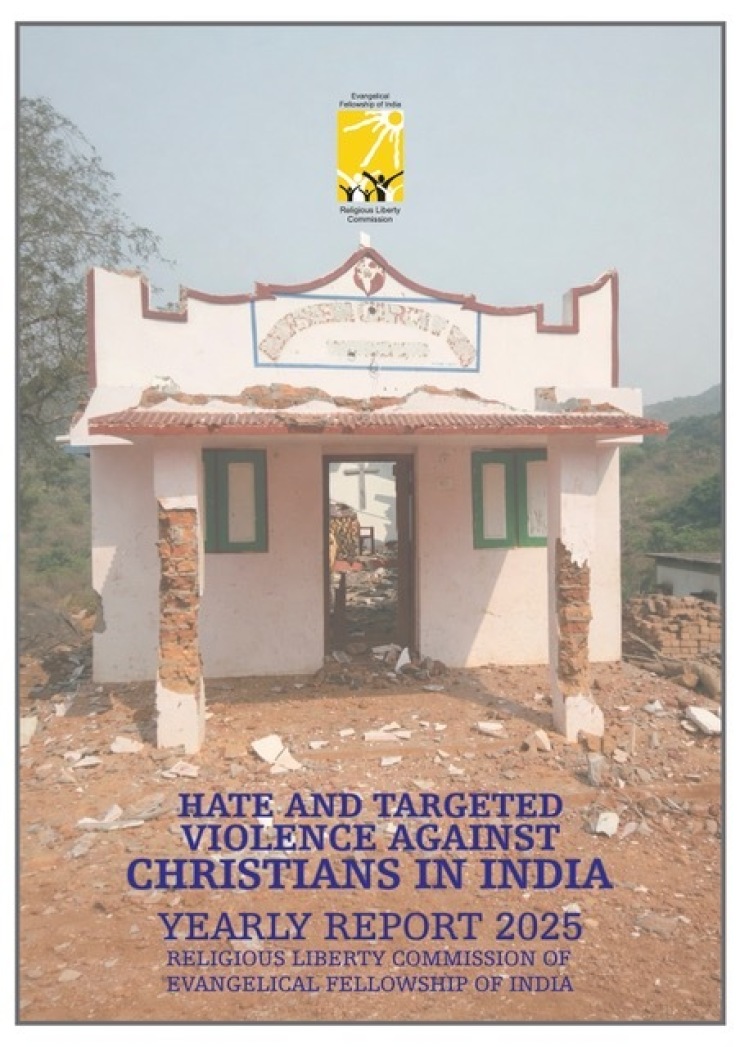
December was the worst month. Eighty-five verified cases of anti-Christian violence and discrimination were recorded as Advent and Christmas drew Christian communities into more visible worship. Attackers, it appears, were watching.
That single month captures something essential about what the Evangelical Fellowship of India's Religious Liberty Commission documented across 2025: a pattern in which attacks intensified whenever Christian communities gathered for prominent occasions. By the end of the year, the Commission had verified 747 cases nationwide, up from 640 in 2024, and five times the 147 incidents recorded in 2014. Christians make up roughly 2.3 percent of India's population, according to the 2011 census.
A Year That Opened With a Miscarriage
The year began with a stark act of violence. On January 2, in Bastar district, village officials and family members assaulted Kunika Kashyap, a pregnant Christian woman. The beating caused a miscarriage. She survived. The perpetrators faced no immediate accountability.
Two months later, on March 9, a mob of 70 to 100 people, including Bajrang Dal members, stormed a Church of God congregation in Raipur. They cut the power supply, beat worshippers, and damaged vehicles parked outside. Easter Sunday brought more coordinated attacks, this time in Gujarat. At Ahmedabad's Western India Pentecostal Church, 25 intruders entered and intimidated those present. In Surat, attackers physically assaulted pastoral staff and caused property damage.
March recorded 78 incidents. October saw 73. The second half of 2025 showed consistent escalation, with June registering 68 cases, September 67, and July 66.
Where the Numbers Came From
The Commission received over 915 complaints during 2025 but verified only those that cleared strict authentication standards, requiring confirmation from multiple independent sources before inclusion in the final count.
Uttar Pradesh accounted for 217 of the 747 verified cases, nearly one-third of the national total. Chhattisgarh followed with 177 cases. Together, the two states contributed close to half of all recorded violations. Substantial numbers also came from Rajasthan with 51 cases, Madhya Pradesh with 47, Haryana with 38, Karnataka with 31, Jharkhand with 30, Bihar with 25, Punjab and Maharashtra with 20 each, and Odisha with 19.
The Commission's data showed no single hotspot logic at work. Violations turned up consistently across states with different demographics, geographies, and political contexts.
Threats, Beatings and Courtrooms
Intimidation and threats formed the largest single category of violations, accounting for 204 cases. Physical assaults followed at 112 incidents, and interference with religious services disrupted 110 gatherings. Other recorded violations included 42 cases of social exclusion, 27 coordinated hate campaigns, 24 instances of property destruction, 8 cases of gender-specific violence, 7 church arsons, and one homicide.
Increasingly, perpetrators also turned to legal mechanisms as instruments of harassment. Authorities carried out 86 arrests and 98 cases involved fabricated accusations or frivolous criminal proceedings. Most centred on allegations of improper religious conversion.
Laws Written for Protection, Used for Persecution
State-level anti-conversion statutes, officially designated as Freedom of Religion Acts, emerged as the primary legal tool for targeting Christians. In Uttar Pradesh, authorities regularly invoked the Unlawful Religious Conversion Prohibition Act against pastors and church members conducting ordinary worship. Police frequently detained or interrogated believers before gathering any evidence of wrongdoing. Home prayer gatherings faced accusations of coercion or inducement without prior investigation.
Rajasthan joined the list during 2025, when its legislature passed the Prohibition of Unlawful Conversion of Religion Bill. Within days, around 50 Bajrang Dal members surrounded Jaipur's Hindustan Bible Institute on September 23 during a routine official visit.
Pastor Wazir Singh of Nohar city in Hanumangarh district experienced this machinery directly. On September 28, Hindu extremists stormed his church service, physically assaulted worshippers, and demanded he renounce Christianity and promote Hindu teachings instead. When he refused, police arrested him and charged four members of his congregation.
What the Numbers Do Not Capture
The EFIRLC was direct in acknowledging the limits of its own report. The 747 verified cases do not represent the full scale of persecution. Many incidents go unreported because victims fear retaliation, face social pressure, or lack access to legal recourse, particularly in rural areas.
The organisation called on both central and state governments to reaffirm constitutional protections for religious freedom, ensure accountability for mob violence, address the deliberate misuse of anti-conversion laws, and provide timely legal remedies and support to victims.