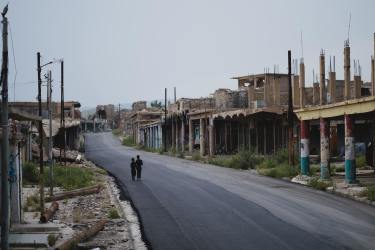
Syria has declared an immediate nationwide ceasefire with the Kurdish-led Syrian Democratic Forces (SDF), bringing nearly two weeks of fighting to an end. However, Christians and other minority communities say the agreement has done little to calm fears of continued violence and insecurity.
State media in Syria reported that the ceasefire is part of a wider 14-point agreement under which the SDF will be absorbed into Syria’s military and security institutions. President Ahmed al-Sharaa said the deal would allow the government in Damascus to regain control of the northeastern and eastern regions of al-Hasakah, Deir Ezzor and Raqqa. These areas contain much of the country’s oil and gas resources.
The agreement followed talks in Damascus between President al-Sharaa and the United States’ special envoy to Syria, Tom Barrack. Barrack described the deal as a step towards a “unified Syria”, according to reports.
Under the terms of the agreement, Syrian authorities will take over civilian institutions, border crossings and energy facilities that were previously run by the SDF. SDF fighters are expected to be integrated into Syria’s defence and interior ministries after a vetting process. Damascus will also assume control of prisons and detention camps holding tens of thousands of captured Islamic State fighters and their families.
The deal includes promises to recognise Kurdish cultural and language rights. These include granting Kurdish official language status and recognising the Kurdish new year as a national holiday. If implemented, this would mark the first formal recognition of such rights since Syria gained independence in 1946.
SDF commander Mazloum Abdi confirmed the agreement in remarks broadcast on Kurdish television. He said the ceasefire was intended to prevent a wider war and described the recent clashes as having been “imposed” on his forces. Kurdish media reported that Abdi stressed his commitment to preserving the gains of Kurdish self-rule established during Syria’s civil war.
Despite international coverage portraying the ceasefire as a stabilising step, a Christian Syrian Kurd refugee living in Europe told Christian Daily International that minorities remain deeply concerned.
He said that Kurds, Alawites, Druze and Christians have all faced increasing violence since the change of government. He pointed to reported attacks on Alawite communities on the Syrian coast, violence against Druze in the south, explosions at churches in Damascus and recent assaults on Kurdish areas.
The refugee also said that public celebrations marking what authorities called the “liberation of Syria” had heightened fears. He described armed fighters chanting Quranic verses and making threats associated with the Islamic State group.
He warned that the transfer of control over detention centres previously run by the SDF poses further risks. He said that Syrian authorities had recently taken over a prison in Raqqa holding around 5,000 Islamic State prisoners captured since 2015, raising concerns about possible releases and a resurgence of extremism.
Such a development, he said, would place all non-Muslims, and many Muslims, in serious danger.
The refugee criticised what he described as a simplified picture of Syria in parts of the European media, including discussions in Germany about encouraging Syrian refugees to return and renewing diplomatic ties with the new leadership.
He said that, as a Kurd and a convert from Islam to Christianity, he could never safely return to Syria. Even if he did, he said he would live under constant threat if his beliefs were discovered.
He acknowledged that the agreement’s promises to recognise Kurdish language rights and protect Kurdish culture were positive in principle, but said they remained unproven. “These are only promises,” he said, adding that real change had yet to be seen.
Concerns about the safety of Christians in Syria reflect recent findings by the charity Open Doors. The organisation ranked Syria sixth on its World Watch List 2026, released in January. Syria rose sharply from 18th place the previous year after a surge in violence against Christians.
Open Doors reported that Syria’s overall persecution score reached its highest level ever, following killings, church attacks and the forced closure of Christian institutions. It estimates that about 300,000 Christians remain in the country, far fewer than a decade ago.
The group said that at least 27 Christians were killed for their faith during the reporting period, noting that the true number is likely higher. It also referred to a suicide bombing at a Greek Orthodox church in Damascus in June 2025 that killed 22 worshippers and injured dozens more.
Since the fall of Bashar al-Assad’s government in December 2024, Syria’s interim constitutional framework has concentrated power in the presidency and made Islamic law the main source of legislation, according to Open Doors. The organisation warned that growing Islamist influence and political instability continue to expose Christians and other minorities to serious pressure.
Adapted from Christian Daily International.