Pope Leo XIV and Ecumenical Patriarch Bartholomew I signed a joint declaration on Saturday, November 29, committing their churches to pursue full communion, marking a significant step in Catholic-Orthodox relations during an ecumenical pilgrimage commemorating 1700 years since the Council of Nicaea.
The declaration, signed at the Patriarchal Palace in Istanbul, states that both leaders will “continue to walk with firm determination on the path of dialogue, in love and truth, towards the hoped-for restoration of full communion between our sister Churches.”
The document identifies the Nicene Creed as the foundation binding Catholics and Orthodox together, describing the shared belief in Christ as “true God from true God, homoousios with the Father.” It acknowledges obstacles preventing reunion whilst emphasising that the faith expressed in the Nicene Creed unites the two traditions.
The signing marks the 60th anniversary of the 1965 statement by Pope Paul VI and Ecumenical Patriarch Athenagoras, which lifted the mutual excommunications of 1054 that had divided the churches for over 900 years. That earlier declaration had called for dialogue leading to restored communion “in that full communion of faith, fraternal accord and sacramental life which existed among them during the first thousand years of the life of the Church.”
Building on this legacy, Saturday’s statement expresses support for the Joint International Commission for Theological Dialogue between the Roman Catholic Church and the Orthodox Church, which is examining historically divisive issues. It urges clergy and theologians to embrace the progress achieved and work towards further advances.
One practical outcome discussed concerns the date of Easter. The document notes that this year all Christian denominations celebrated Easter on the same day and expresses the desire to establish a permanent common date. The First Council of Nicaea had originally provided criteria for determining when all Christians would mark the feast.
Beyond church unity, the declaration addresses contemporary global challenges. It rejects “any use of religion and the name of God to justify violence” and appeals to political leaders to end conflicts immediately.
On environmental and social justice issues, the statement calls on people of goodwill to build a more equitable world and care for creation. It identifies indifference, domination, greed and xenophobia as obstacles the human family must overcome.
The text also highlights the 60th anniversary of Nostra Aetate, the Second Vatican Council’s declaration on relations with non-Christian religions, affirming that genuine interreligious dialogue is essential for peaceful coexistence among peoples of different traditions and cultures.
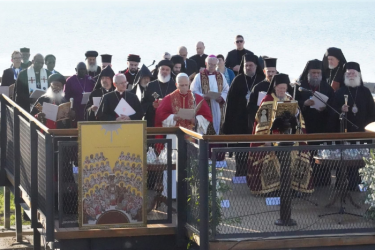
The signing took place during Pope Leo XIV’s first international visit, a four-day pilgrimage to Turkey from November 27 to 30. The centrepiece was a commemoration on November 28 at Iznik, the ancient Nicaea, where the first ecumenical council met in 325 AD.
At the Iznik service, representatives from multiple Christian traditions gathered, including the Anglican Communion, Lutheran World Federation, World Methodist Council, Baptist World Alliance, Pentecostal World Fellowship and World Evangelical Alliance. The service concluded with leaders reciting the Nicene-Constantinopolitan Creed together in English, omitting the Filioque clause which has been a point of division between eastern and western churches since the 11th century.
The Rt Revd Anthony Poggo, Secretary General of the Anglican Communion, described the declaration as “an important step in the pursuit of unity and an encouragement to all Christians to respond earnestly to Christ’s call to be one.”
At the conclusion of the Divine Liturgy on November 30 at the Patriarchal Church of Saint George, Pope Leo XIV confirmed that pursuing unity among all baptized Christians ranks among the priorities of the Catholic Church and of his ministry as Bishop of Rome. He expressed gratitude to Patriarch Bartholomew for supporting the theological dialogue commission and hoped that all autocephalous Orthodox Churches would return to active participation in this work.
The Pope identified three challenges requiring joint Catholic-Orthodox response: promoting peace amid global conflicts, addressing the ecological crisis through spiritual and communal conversion, and ensuring responsible use of new technologies so their benefits serve integral human development rather than privileged interests.
In his address at Iznik, Pope Leo XIV had stated that universal fraternity exists among all people regardless of ethnicity, nationality or religion. He said religions should encourage individuals and peoples to recognize and practise this truth.
The Pope also warned against what he termed a “new Arianism” in contemporary culture, where Jesus is admired on a purely human level but not truly regarded as God. He said this occurs when Christ’s divinity and lordship over history are overshadowed, reducing him to merely a historical figure, teacher or prophet.
At the Armenian Apostolic Cathedral on November 30, Pope Leo XIV greeted Armenian Patriarch Sahak II and expressed gratitude for the courageous Christian witness of the Armenian people throughout history. He thanked God for the growing fraternal bonds between the Armenian Apostolic Church and the Catholic Church, noting that the “dialogue of charity” between the two has flourished since the 1960s.
The Pope recalled that in May 1970, Catholicos Vasken I signed with Pope Paul VI the first joint declaration between a Pope and an Oriental Orthodox Patriarch, inviting their faithful to rediscover themselves as brothers and sisters in Christ. He expressed hope that the Joint International Commission for Theological Dialogue between the Catholic Church and the Oriental Orthodox Churches would resume its work promptly.
The choice of Turkey for this ecumenical milestone carries historical significance. The land hosted the first eight ecumenical councils and was home to early Christian communities established by the apostles. However, Christians now constitute less than 0.2 per cent of Turkey’s population, numbering around 200,000 people.
The Pope’s journey began on November 27 in Ankara, where he met President Recep Tayyip Erdogan at the presidential palace. In his address, Pope Leo XIV emphasised universal fraternity and paid tribute to John XXIII, known as “the Turkish pope” for his service as apostolic delegate to Turkey from 1935 to 1945.
On November 29, before the declaration signing, Pope Leo XIV visited the Sultan Ahmed Mosque in Istanbul as a symbol of interfaith dialogue. That evening, he celebrated Mass at the Volkswagen Arena, bringing together Catholics from across the region.
In his homily, the Pope reflected on three bonds requiring care: unity within the Catholic community itself across its different liturgical traditions in Turkey, ecumenical relations with other Christian denominations, and encounters with members of non-Christian communities. He said the world too often sees religion used to justify wars and atrocities.
The joint declaration concludes by entrusting to God every human being, especially those experiencing hunger, loneliness or illness, invoking grace and blessing upon each member of the human family.
Pope Leo XIV departed Istanbul on November 30 afternoon for Lebanon, continuing his apostolic journey.
Image added to this article from here.