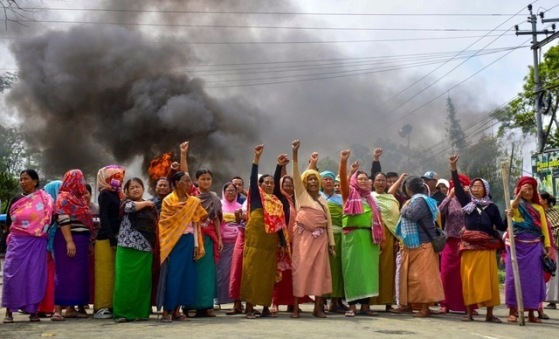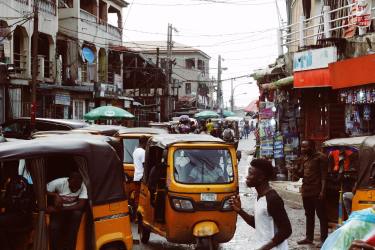
Christians in parts of Nigeria remain fearful after a series of violent attacks, including the recent release of a priest who was held captive for 61 days, sources report.
The Rev. Bobbo Paschal of St. Stephen Catholic Parish in Kushe Gugdu village, Kaduna state, was released on 17 January after being kidnapped on 17 November. On the same day, church member Gideon Markus was killed, and two other parishioners remain in captivity, according to the Catholic Archdiocese of Kaduna.
Community leader Innocent Yakubu said the attack, carried out by Fulani herdsmen, has left the village traumatised. “The entire community remains in fear as we continue to seek safety that no longer exists,” he told Christian Daily International-Morning Star News. Yakubu added that repeated attacks over the years have destroyed lives and livelihoods.
Other villages in the area, including Aribi, Ungwan Pah, Dogon Daji and Kurmin Lemu, have also experienced assaults in recent weeks. On 5 February, 166 Christians kidnapped in Kurmin Wali were released after being held by armed groups, the Rev. Joseph Hayab, chairman of the Christian Association of Nigeria (CAN) for Northern Nigeria, confirmed. No ransom was reportedly paid, and the government handled the negotiations.
The attacks are part of a wider pattern of religious violence in Nigeria’s Middle Belt and northern states, where Christian communities have frequently been targeted by Fulani militants, Boko Haram, and the Islamic State West Africa Province (ISWAP). Open Doors’ 2026 World Watch List reported that of 4,849 Christians killed worldwide between 1 October 2024 and 30 September 2025, 3,490, or 72 per cent, were in Nigeria.
Religious freedom advocates have warned of the growing threat. At a 4 February hearing of the U.S. House Foreign Affairs Committee, former U.S. Ambassador-at-Large for International Religious Freedom Sam Brownback described Nigeria as “the deadliest place on the planet to be a Christian,” citing the expansion of militant Islamist groups across Africa and the Middle East.
Stephen Schneck, former chair of the U.S. Commission on International Religious Freedom, highlighted poor governance and insecurity as major factors contributing to attacks on Christian communities. Committee chairman Chris Smith (R-NJ) urged the U.S. to hold Nigeria accountable for protecting citizens and prosecuting perpetrators, and to apply sanctions or other measures where necessary.
Meanwhile, the American Center for Law and Justice (ACLJ) filed a petition at the United Nations on genocide against Christians in Nigeria. Within 16 hours, the petition received broad support, with over 517,000 signatures collected in less than a day. ACLJ President Jordan Sekulow noted that Christians in Nigeria face constant threats of abduction, torture, and murder by radical Islamist groups, including Fulani extremists.
Experts emphasise that while most Fulani are not extremists, some groups adopt radical Islamist ideologies, often targeting Christians and their communities. Analysts and local church leaders assert that attacks are partly motivated by efforts to seize land and impose Islam, as environmental challenges limit herding livelihoods.
The violence has spread beyond the Middle Belt, with new extremist groups such as Lakurawa, linked to Al-Qaeda in Mali, appearing in northwest Nigeria. Jihadist attacks now include killings, sexual violence, abductions for ransom, and targeted raids on Christian communities across several states.
Original reporting by Christian Daily International and Morning Star News, rewritten for this publication.