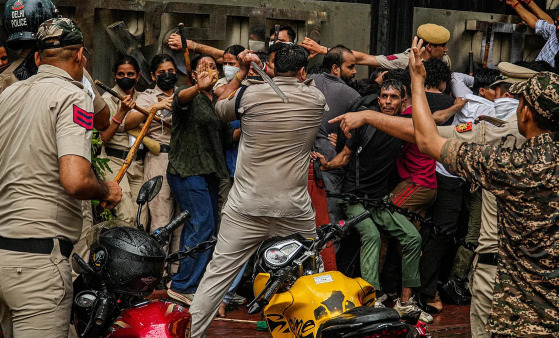
A mob attacked Christian tribals and manhandled police in Gram Panchayat Bade Tevda, Kanker district, on 17 December, demanding exhumation of a body buried a day earlier according to Christian rites.
The violence erupted after Rajman Salam, the democratically elected Sarpanch, buried his father on 15 December in accordance with Christian traditions. The following day, a large mob led by Sukdu Ram incited villagers, falsely claiming they had the right under the Panchayats (Extension to Scheduled Areas) Act to exhume the body, asserting the land belonged to a local deity and the Christian burial constituted an insult.
Video evidence shows the mob beating Christian tribals with lathis and physically confronting police officers. Mansu, a Christian tribal, suffered a head injury requiring hospitalization. A woman, identified as Rajman’s sister-in-law, sustained a serious head injury, while Pastor Siddhnath Chandra and several other Christians were also injured. RSS-affiliated groups reportedly threatened to return on 18 December in larger numbers.
The incident occurred in the Kanker Lok Sabha constituency represented by BJP MP Bhojraj Nag. Members of the Christian community, who requested anonymity citing fear of retribution, allege that the MP is behind the systematic targeting of Christians in the area. The community remains fearful following the violence.
Heavy police deployment followed the incident, with Section 144 imposed and outsiders barred from the village. The situation was aggravated by selective citation of the Supreme Court’s January 2025 split verdict in the Ramesh Baghel burial case, which was being misquoted locally to justify assault and intimidation. Around 100 believers gathered at Rajman Salam’s house, seeking safety in numbers.
The Kanker incident is the latest in a series of burial denials affecting Christian communities across Chhattisgarh. In November 2025, two similar incidents were reported by the Indian Express.
On 8 November, Raman Sahu, a 50-year-old resident of Jewartala village in Balod district, died at a private hospital. When his family, who had converted to Christianity several years ago, brought his body home for burial, villagers obstructed and vandalised the procession, insisting last rites proceed under traditional Hindu rituals. Balod District Police Chief Yogesh Patel confirmed to the Indian Express that the denial originated solely from the family’s conversion, with villagers remaining “adamant” despite administration pleas. The body was kept in a funeral home overnight before the family interred Sahu on 10 November at the Sankra burial ground, several miles away.
Days earlier, on 5 November, Manoj Nishad, a 50-year-old who had embraced Christianity months earlier, died during treatment in Raipur. His family wanted to bury him on their private land in Kodekurse village, Kanker district. However, residents blocked access, declaring that converts who “abandon the traditional faith” no longer had burial rights in the village. The family spent three days moving the body between villages in search of a burial site, with Hindu organisations reportedly intervening to halt proceedings. Villagers even floated a condition that burial would be permitted if the family reconverted. The body was ultimately transported back to Raipur, where it remained unburied until the family secured a distant spot.
These incidents form part of a troubling pattern. In May 2025, a Christian woman in Sanaud village endured an eight-hour blockade at a public burial ground. Despite police and sub-divisional magistrate presence, villagers refused to allow burial. The family buried her 19 miles away in Dhamtari. More than 350 such incidents have been reported in Bastar District alone.
The most high-profile precedent came in January 2025, when the Supreme Court issued a split verdict in the case brought by Ramesh Baghel, whose father Pastor Subhash Baghel, a Dalit Christian from Chhindawada village in Bastar, was refused burial in the village following a tribal gram sabha resolution that barred converts. The body remained in a mortuary for three weeks before the court ordered interment at a Christian cemetery about 15 miles away. An affidavit from the Additional Superintendent of Police stated that “any person who has forsworn the tradition of the community or has converted into a Christian is not allowed to be buried at the village graveyard.”
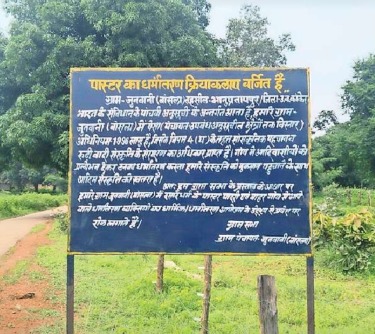
In October 2025, more than 400 villagers from more than 20 villages in Kanker district gathered and decided to strip Christians of their burial rights, including access to common lands, citing concerns that conversions to Christianity would affect their cultural identity and traditions.
Statistics underscore the escalation. From January to July 2025, the Evangelical Fellowship of India’s Religious Liberty Commission documented 334 verifiable incidents of violence, harassment and discrimination against Christians. Such incidents have grown fivefold over the past decade, from 127 cases in 2014 to 834 in 2024. The United Christian Forum reported 579 incidents by September 2025, yet only 39 resulted in police cases, a 93 per cent gap in justice.
“The right to dignified burial is sacred. When communities are denied even this basic humanity, it reveals a systematic campaign of persecution. That democratically elected officials face such violence with impunity shows a complete erosion of constitutional protections,” said Rev. Vijayesh Lal, General Secretary of the Evangelical Fellowship of India while speaking to Christian Today.
Since 2023, tensions have increased after the Hindu-nationalist Bharatiya Janata Party took power. The state inherited the Chhattisgarh Freedom of Religion Act, 2006, an anti-conversion law imposing up to four years imprisonment for “forced” conversions. In 2025, Deputy Chief Minister Vijay Sharma announced a “stricter” version requiring 60-day prior notice for religious conversions and banning “changai sabhas,” where “religious and faith healers present miracles to attract the tribal people.” In September 2025, Raipur authorities banned more than 200 house churches to “maintain harmony,” following complaints of conversions.