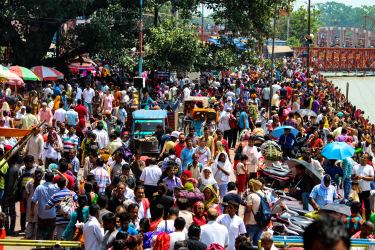
India has confirmed that its long-awaited national census will be carried out in two stages between 2026 and 2027, marking the country’s first fully digital population survey. With an estimated 1.47 billion people, it will be one of the largest census operations in the world.
The census, normally held every ten years, was last completed in 2011. The 2021 round was delayed first by the Covid-19 pandemic and then by the 2024 general elections.
The Registrar General of India (RGI), the office overseeing the exercise, has instructed all states and union territories to finalise the selection of census workers by January 2026. These workers will include enumerators, each responsible for around 700-800 residents, and supervisors, who will guide teams of six enumerators. A reserve pool of extra personnel will also be created to cover unexpected gaps.
Before being officially appointed, selected workers must be registered on the Census Management and Monitoring System (CMMS), a digital platform built to oversee every stage of the process.
Data will be collected mainly through a mobile app, while households will have the option to submit their information online. To reflect India’s linguistic diversity, the app will function in English, Hindi and 16 additional regional languages.
The process will unfold in two phases. The first, focused on listing and mapping all dwellings, will take place over a 30-day period sometime between April and September 2026, depending on each state’s schedule. The second phase, covering the full population count, is set for February 2027. Areas with harsh climates or difficult terrain, including Ladakh, parts of Jammu and Kashmir, Himachal Pradesh and Uttarakhand, will be surveyed earlier, in September 2026.
For the first time since 1931, the census will gather information on caste groups. It will also record more detailed data on migration, including a person’s place of birth, last residence, length of stay and reasons for moving.
Census findings play a crucial role in shaping social programmes, distributing federal funds, planning elections and informing national policy. Observers note that the results may have far-reaching consequences, particularly for communities that rely on government support.
India joins a growing list of nations using digital or hybrid census methods, such as the United States, the United Kingdom, Ghana and Kenya. Digital tools are expected to speed up results, with provisional figures possible within ten days, and reduce errors, especially in areas where paper-based surveys have previously led to gaps.
However, concerns remain. Limited internet access in several rural and remote regions, including parts of the north-east and the Himalayan belt, could make it harder for vulnerable communities to participate. Older citizens and people with limited digital literacy may also face barriers, raising questions about whether the survey will capture the whole population accurately.
Adapted from Asia News.