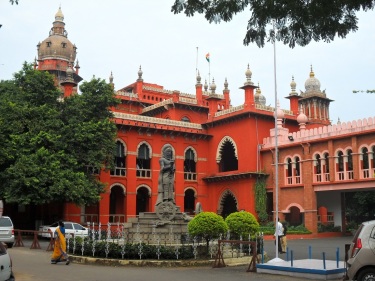
The Madras High Court has ruled that a Catholic religious order is entitled to Rs 56 lakh held in a deceased priest’s fixed deposit account, ordering his relatives to return the money.
In its ruling on 13 October, the court’s Madurai bench in Tamil Nadu directed the relatives of Father Deivakumar Arulanantham to repay the amount to the Society of Catholic Apostolate, widely known as the Pallottines, within one month. If they fail to meet the deadline, the outstanding amount will carry annual interest of 9 per cent.
The judges also referred to the Ten Commandments, highlighting the biblical prohibition against stealing and stating that no one has the right to retain property that belongs to another person.
The decision overturned a September 2024 ruling by a district court in Karur, Tamil Nadu, which had recognised three of the priest’s relatives as his legal heirs and allowed them to withdraw the money despite objections from the religious order.
Father Arulanantham, who worked as a motivational speaker, died in February 2018 while receiving treatment at a private hospital in Bengaluru, Karnataka.
The Assumption of the Blessed Virgin Mary Province of the Society of Catholic Apostolate challenged the district court’s decision, arguing that the priest’s religious vows and the circumstances in which he acquired the money meant the funds belonged to the religious community.
The society maintained that the deposits were not simply the priest’s personal savings but were held for the benefit of the religious community. It also referred to Catholic canon law in support of its claim.
The order further argued that the relatives could not claim the money solely because of their family relationship with the priest or because he had named them as beneficiaries of the fixed deposit.
Before his death, Father Arulanantham had written a note authorising the religious society to take possession of his personal belongings, excluding property inherited from his ancestors.
His relatives disputed the claim, arguing that taking religious vows did not prevent him from owning property. They maintained that they were entitled to inherit his estate under Indian succession law and that his decision to name them as beneficiaries entitled them to receive the deposit.
A division bench comprising Justices N. Anand Venkatesh and K. Ramakrishnan ruled that the fact that the deposits were held in the priest’s name was not enough, by itself, to establish ownership.
The judges said his religious commitments and the circumstances in which the money was acquired were important factors in deciding who was entitled to it.
The bench also clarified the meaning of “civil death”, a concept associated with entering a religious order. It refers to renouncing worldly interests and relationships, but does not mean that a person loses their legal identity or all civil rights.
The judges distinguished between property acquired during religious life and assets owned independently, including property inherited from family members. They stressed that such inherited property does not automatically become the property of a religious order.
Church law expert Father Michael Almeida welcomed the judgment, describing it as the correct interpretation of the law.
Almeida said the ruling should be understood in the context of religious orders whose members take a vow of poverty. Religious communities generally provide for the needs of their members, including priests and nuns, and those who take such vows are not expected to accumulate personal wealth independently of their community.
He added that money and gifts received by members of religious orders, including those from family members, should be handed to their superiors, who decide how the funds are used.
Diocesan priests, by contrast, generally do not take a vow of poverty and are ordinarily free to accumulate personal assets and decide who should inherit them, Almeida said.
Based on reporting by UCA News.